
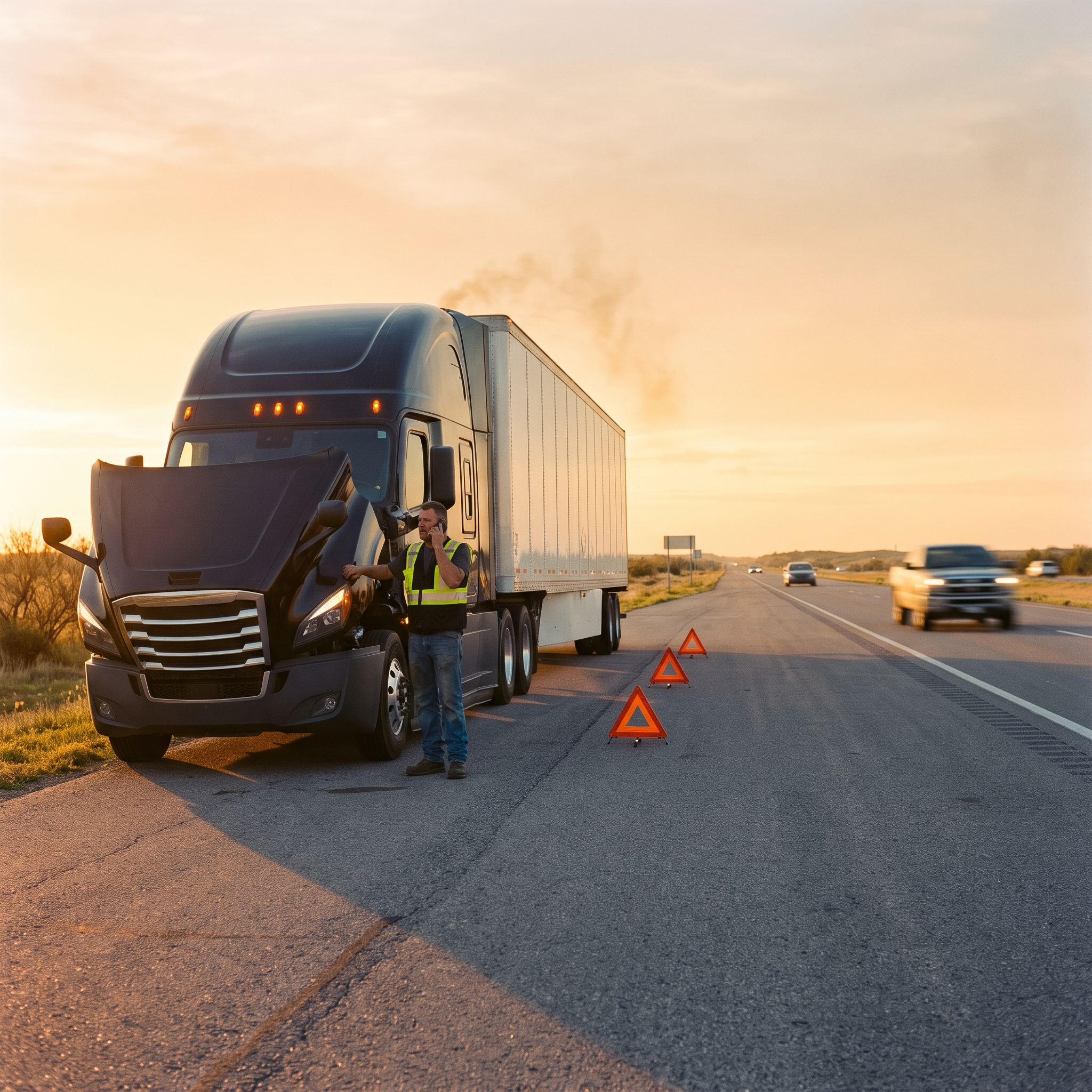
The dash lights up. Power drops. Your truck is crawling down the shoulder of I-40 at 5 mph with a load due in six hours.
That’s an aftertreatment fault — and it’s one of the most common reasons heavy-duty trucks go down on the road today.
It’s also one of the most expensive. A plugged DPF can turn into a $3,000–$5,000 emergency repair. A full system failure involving the DPF, SCR and DOC can run $15,000–$25,000. And that’s before you count a single hour of downtime.
Here’s what fails, what it costs, and how to get the truck moving again — fast.
What Your Aftertreatment System Actually Does
Every modern diesel — Class 8 tractors, buses, diesel pusher RVs — runs exhaust through four stages:
- DOC (Diesel Oxidation Catalyst): Starts the chemistry and builds heat for regens.
- DPF (Diesel Particulate Filter): Traps soot and ash, then burns it off during regeneration.
- SCR + DEF (Selective Catalytic Reduction): DEF is injected into the exhaust, and the SCR catalyst converts NOx into nitrogen and water.
- Sensors: NOx, temperature and pressure sensors police the whole system.
When any piece reports a problem, the ECM protects emissions compliance the only way it knows how: it derates the engine. That’s why a sensor worth a few hundred dollars can park a $180,000 truck.
The 6 Most Common Aftertreatment Faults — and What They Cost
1. Clogged DPF
What causes it: Short-haul routes, heavy idling, interrupted regens, bad injectors, or oil, fuel and coolant leaks loading the filter.
Warning signs: Frequent regen requests, DPF light, rising backpressure, loss of power.
What it costs: An off-vehicle DPF cleaning typically runs around $500–$1,000. Wait until it forces a derate on the road and you’re looking at $3,000–$5,000. A cracked or melted filter that needs replacement can climb higher.
Pro tip: A plugged DPF is usually a symptom. Fix the root cause — injector, turbo seal, coolant leak — or you’ll be cleaning it again in a few thousand miles.
2. NOx Sensor Failure
NOx sensors live in brutal heat and vibration. Crystallized DEF and excess soot kill them early. When one fails, the ECM can’t verify emissions — and it starts pulling power.
What it costs: Plan on roughly $500–$1,500 installed on most Class 8 platforms, depending on OEM part and labor rate. The swap itself is usually under two hours. The real risk: some OE sensors sit on backorder for weeks, which turns a cheap part into a costly downtime event.
3. DEF Doser and Injector Problems
DEF crystallizes. When it builds up in the doser nozzle, the SCR can’t get the fluid it needs, and you’ll see efficiency or dosing codes.
What it costs: About $200–$600 per injector, plus diagnostic time. Often a mobile mechanic fix.
4. Contaminated DEF or Misfueling
This is where small mistakes get huge:
- Bad or non-certified DEF: System flush up to catalyst damage — roughly $800–$5,500.
- Diesel in the DEF tank: Around $5,000.
- DEF in the fuel tank: Around $15,000 — and worse if the driver keeps running it.
If a driver realizes they’ve misfueled, don’t start the truck. Call for help first.
5. SCR Efficiency Faults (P20EE)
A P20EE means the SCR isn’t converting enough NOx. The cause could be bad DEF, a failed sensor, a stuck doser, or a poisoned catalyst. Diagnose before you buy parts.
What it costs: Anywhere from a few hundred dollars for a sensor or cleaning to $2,800–$4,000+ for catalyst replacement.
6. DOC Damage and Full System Failure
Coolant and fuel leaks can foul the DOC and crack the DPF. Once damage cascades through multiple components, you’re in the worst-case bracket: $15,000–$25,000 for a full aftertreatment rebuild.
Aftertreatment Repair Cost at a Glance
| Fault | Typical Repair Cost | Roadside Fix? |
|---|---|---|
| DPF cleaning (planned) | ~$500–$1,000 | No — off-vehicle |
| Clogged DPF (emergency) | $3,000–$5,000 | Sometimes (forced regen) |
| NOx sensor | ~$500–$1,500 | Often |
| DEF injector/doser | $200–$600 per injector | Often |
| DEF contamination | $800–$5,500 | Rarely |
| Diesel in DEF tank | ~$5,000 | No |
| DEF in fuel tank | ~$15,000 | No |
| SCR catalyst replacement | $2,800–$4,000+ | No |
| Full aftertreatment failure | $15,000–$25,000 | No |
The Bill Nobody Prints: Downtime
The repair invoice is only half the hit.
Add the tow. The mobile diagnostic call. The missed delivery window. The driver’s hotel. The load that goes to another carrier. For owner-operators, a roadside aftertreatment breakdown costs roughly $500 a day in lost income on average — and many fleets find that downtime ends up costing more than the repair itself.
That’s why speed matters more than anything once the truck is down. Every hour you spend calling shops that don’t do heavy-duty, don’t answer at 2 a.m., or don’t have a DPF tech is money gone.
Warning Signs Before the Derate Hits
Aftertreatment problems usually announce themselves days or weeks before they park the truck. Train drivers and dispatch to flag:
- Regens happening more often than normal
- DEF consumption that’s off — normal is about 2–3% of fuel burned
- Amber engine or DPF lights and stored fault codes
- Sudden drop in fuel economy
- Excess smoke or a strong exhaust smell
- DEF quality or level warnings
Catch it early and it’s a scheduled shop visit. Ignore it and it’s a shoulder, a wrecker and a lost load.
Truck in Derate? Do This, in This Order
- Get safe. Hazards on, triangles out, off the travel lane.
- Pull and write down the codes. Your vendor needs them to send the right tech with the right parts.
- Check the basics. DEF level, obvious leaks, a regen that got interrupted.
- Don’t clear codes and keep running. That’s how a $600 problem becomes a $6,000 one.
- Get a vetted heavy-duty vendor on the line. Not the first result on Google.
Mobile Mechanic or Tow?
Mobile mechanic: NOx sensors, DEF dosers, wiring and connector faults, forced or parked regens. Many of these get the truck rolling the same day.
Heavy-duty tow: Cracked DPF, poisoned catalyst, misfueling, or any situation where running the engine risks more damage.
Why a Delete Isn’t the Fix
When a truck keeps going into derate, someone always suggests a delete. Don’t.
Removing or disabling a DPF, SCR or DEF system is emissions tampering under the federal Clean Air Act. It means fines, failed inspections, voided warranties and a truck that’s harder to sell. Enforcement changes in 2026 are not a green light.
Worth watching: in July 2026, the EPA proposed replacing DEF-failure derates with audible and visual alerts on new engines. It’s a proposal, and it won’t help the trucks already on the road. Proper repair is still the only real fix.
Bus and RV Owners: Same Systems, Fewer Shops
Diesel pushers, coaches and school buses run the same DPF and SCR systems as Class 8 trucks — but plenty of shops won’t touch them, and standard tow companies don’t have the equipment. BusAndRVRescue.com connects you with vetted vendors who handle bus and RV aftertreatment repair and heavy-duty towing.
Aftertreatment FAQ
How much does it cost to fix a DPF on a semi truck?
A planned off-vehicle cleaning typically runs around $500–$1,000. An emergency DPF repair commonly runs $3,000–$5,000. A full aftertreatment failure can reach $15,000–$25,000.
Can a mobile mechanic fix an aftertreatment fault on the road?
Often, yes. Sensors, dosers, wiring and forced regens are frequently roadside jobs. Cracked filters, poisoned catalysts and misfueling usually need a tow.
Is a DPF or SCR delete legal?
No. It’s emissions tampering under the Clean Air Act and can bring heavy fines, failed inspections and voided warranties.
Get a Vetted Aftertreatment Vendor in Under 3 Minutes
Truck down with a DPF, SCR or DEF fault? Heavy Duty Help connects you with vetted heavy-duty mobile mechanics, repair shops and towing and recovery vendors — in every U.S. state and across Canada, 24/7.
- Fleet dispatchers: Search by service and location at HeavyDutyHelp.com — trusted by 800+ major trucking companies.
- Owner-operators: Find help fast at RepairAndTowPros.com — part of a network serving 250,000+ owner-ops.
- Bus and RV owners: Go to BusAndRVRescue.com.
Or call 256-867-2257. A live team member finds a vetted vendor near you and connects you by phone — average time, under 3 minutes. Free to use. No automated dead ends.
Real Help. Real Fast. Real 24/7. — Keep America Moving.
Vendors: Do aftertreatment, DPF or mobile diesel repair? Get in front of 800+ fleets with one flat annual listing — no bidding, no rotation. Join the network.