
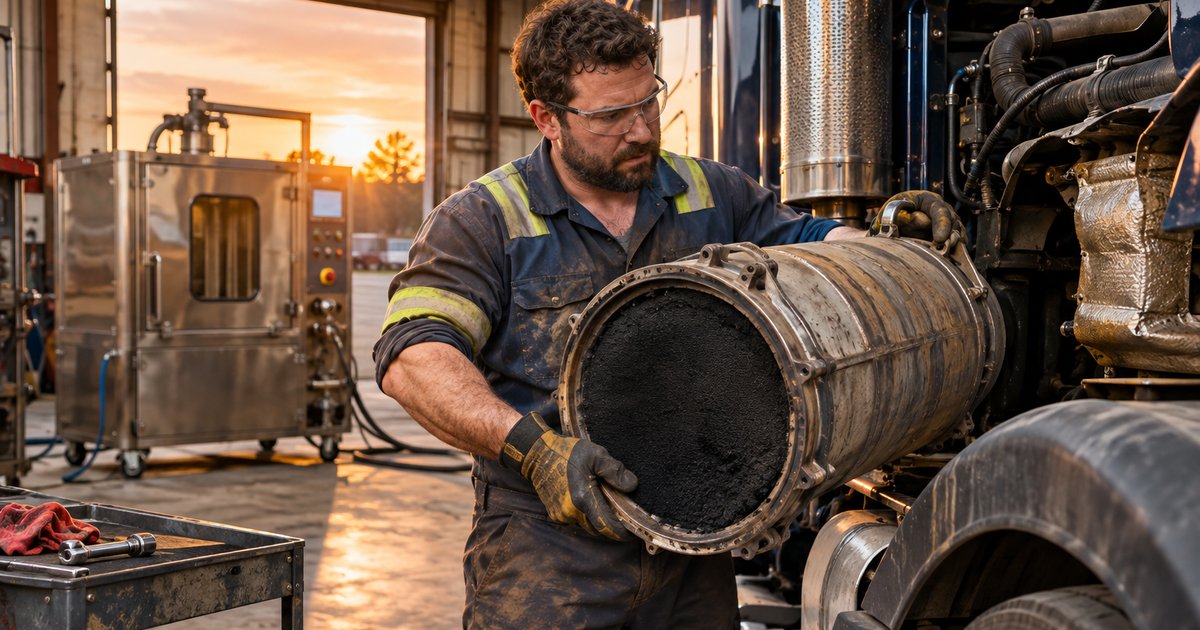
The truck’s regenerating twice as often as it used to. Fuel mileage is off half a mile per gallon. The DPF light came on again this morning.
Your diesel particulate filter is loading up with ash, and regens can’t burn ash. It needs a cleaning. Here’s how to tell, what it costs, and where to get it done fast.
What a Dirty DPF Means
The DPF sits in the exhaust and traps the soot your engine makes. Regeneration burns that soot off with heat.
But soot isn’t the only thing in the filter. Engine oil burns in tiny amounts, and it leaves ash: metallic residue from oil additives. Ash doesn’t burn. Every regen leaves a little more behind, packed into the filter channels.
Over time, ash cuts the filter’s capacity. The truck regenerates more often, backpressure climbs, and the engine works harder to push exhaust through. At that point, no regen will fix it. The filter has to come off the truck and be cleaned.
Most DPFs need an off-vehicle cleaning somewhere between 150,000 and 300,000 miles, depending on engine, oil and duty cycle.
Common Causes of a Plugged DPF
Ordered from most to least likely.
1. Normal ash buildup. Every DPF reaches its ash limit eventually. This is maintenance, not a failure.
2. Interrupted or skipped regens. Short runs, heavy idling and skipped parked-regen requests let soot pile up faster than the truck can burn it.
3. Idle-heavy and low-speed duty. Vocational, local and yard trucks rarely get exhaust hot enough for passive regen.
4. Engine problems upstream. Leaking injectors, a turbo seal leaking oil, or EGR faults send extra soot and oil into the filter.
5. Coolant or fuel contamination. A leaking EGR cooler or fuel doser can glaze, crack or poison the filter. That’s often a replacement, not a cleaning.
6. Wrong engine oil. Oil that isn’t low-ash (CK-4 or FA-4 rated for your engine) adds ash faster.
How to Diagnose a DPF That Needs Cleaning
Steps 1 through 5 can be done roadside or in the yard. Steps 6 and 7 need a shop.
- Count your regens. Regens much more often than this truck’s normal are the first sign.
- Watch the dash. A DPF lamp that keeps coming back after regens, a flashing DPF lamp, or a high exhaust temperature lamp that stays on too long.
- Track fuel mileage. A steady drop with no other explanation points to backpressure.
- Notice power loss. Sluggish on grades, or a derate.
- Pull the codes. Soot-load and differential-pressure codes point to the filter. Sensor codes may mean the filter is fine and a sensor isn’t.
- Shop step: read soot and ash load. OEM software shows the filter’s loading and the history of completed and failed regens.
- Shop step: find the root cause. Before cleaning, a good shop checks injectors, the turbo, EGR and the doser so the filter doesn’t plug again in a few thousand miles.

Can You Keep Driving With a Clogged DPF?
Rising regens and a slight power drop: yes, but schedule the cleaning now, while it’s still a planned shop visit.
Flashing DPF lamp, stop-engine lamp or a derate: no. Pull over safely. Driving on a plugged filter raises backpressure and exhaust temperatures. A regen on an overloaded filter can crack or melt the substrate. That turns a cleaning into a replacement.
Oil, coolant or fuel smell from the exhaust, or heavy white smoke: stop. Something upstream is feeding the filter, and cleaning it won’t help until that’s fixed.
What DPF Cleaning Costs
Ranges, not quotes.
| Service | Typical cost | Notes |
|---|---|---|
| Off-vehicle DPF cleaning (planned) | $500–$1,000 | Thermal bake plus air pulse |
| Forced regen by a mobile tech | $200–$400 | Clears soot only, not ash |
| Clogged DPF, emergency repair | $3,000–$5,000 | After a derate on the road |
| New DPF | $5,000+ | Cracked, melted or contaminated filter |
| Full aftertreatment failure | $15,000–$25,000 | DPF, SCR and DOC damage |
Ranges come from the Heavy Duty Help aftertreatment cost guide, Fullbay’s DPF reference, and 2026 heavy-duty repair cost guides. Your price depends on filter size, cleaning method and whether the shop also cleans the DOC.
How cleaning works. Most shops use thermal cleaning. They bake the filter for several hours to burn off remaining soot, then blow the ash out with pulsed air. Many shops also run an exchange program. They swap a clean filter onto your truck and clean yours afterward, so the truck rolls the same day.
Clean or replace? Cleaning is the right call when the filter is just full of ash and soot. Replacement is the call when the shop finds a cracked face, melted channels, or oil or coolant soaked into the substrate. A filter that has been cleaned several times may also stop holding its flow rating. Ask the shop for its flow or weight test results so you can see the numbers yourself.
Do the math on waiting. At $500–$1,000, a planned cleaning costs less than one day of downtime for most owner-operators. Skipping it to save a shop visit is how trucks end up in the $3,000–$5,000 emergency bracket, plus a tow.
Finding a Shop for DPF Cleaning
Ask these before you book:
- Do you clean in-house or send it out? In-house means faster turnaround.
- Do you offer exchange filters? A swap gets you rolling in hours instead of days.
- Do you test the filter after cleaning? Good shops flow-test or weigh the filter to prove it’s clean and check for cracks.
- Will you clean or check the DOC too? A plugged DOC face causes many of the same symptoms.
- Will you look for the root cause? Oil, coolant or fuel in the filter means an upstream problem.
Fleets: Put DPF cleaning on the PM calendar by mileage or engine hours instead of waiting for the light. Many cleaning shops will set up exchange stock for a fleet so a swap takes an hour at the yard.
Bus and RV owners: Diesel pushers and motorcoaches use the same DPF systems, but plenty of shops won’t take them. Confirm the shop can lift and reach the filter on your chassis before you drive over.
Search DPF cleaning shops near you on Heavy Duty Help. If the DEF light is on too, see our diesel exhaust fluid guide.
DPF Cleaning FAQs
How much does DPF cleaning cost?
A planned off-vehicle cleaning typically runs about $500 to $1,000. Waiting until the filter plugs and derates the truck can push the bill to $3,000–$5,000. A new filter runs $5,000 or more.
How often should a DPF be cleaned?
Most heavy-duty DPFs need an off-vehicle cleaning every 150,000 to 300,000 miles. Idle-heavy and vocational trucks need it sooner.
Can a regen clean a DPF?
A regen burns soot, not ash. Ash builds up no matter how well you regen, so the filter still needs off-vehicle cleaning.
How long does DPF cleaning take?
The cleaning cycle itself takes hours because of the bake. With an exchange filter, the truck is often back on the road the same day.
Is cleaning cheaper than replacing a DPF?
Yes, by thousands. Replacement is only needed when the filter is cracked, melted or contaminated with oil or coolant.
Get a Vetted DPF Vendor in Under 3 Minutes
DPF light won’t quit? Heavy Duty Help connects you with vetted DPF cleaning shops, heavy-duty mobile mechanics and towing and recovery vendors, in every U.S. state and across Canada, 24/7.
- Fleet dispatchers: Search by service and location at HeavyDutyHelp.com. Trusted by 800+ major trucking companies.
- Owner-operators: Find help fast at RepairAndTowPros.com.
- Bus and RV owners: Go to BusAndRVRescue.com.
Or call 256-867-2257. A live team member finds a vetted vendor near you and connects you by phone, with an average time under 3 minutes. Free to use. No automated dead ends.
Real Help. Real Fast. Real 24/7. Keep America Moving.
Vendors: Do DPF cleaning or aftertreatment repair? Get in front of 800+ fleets with one flat annual listing. No bidding, no rotation. Join the network.
Cost ranges are general industry estimates for Class 8 and comparable heavy-duty diesel equipment and will vary by OEM, region, parts availability and whether the repair is done roadside or in-shop. Heavy Duty Help connects clients with independent vendors and does not set or negotiate repair pricing.