
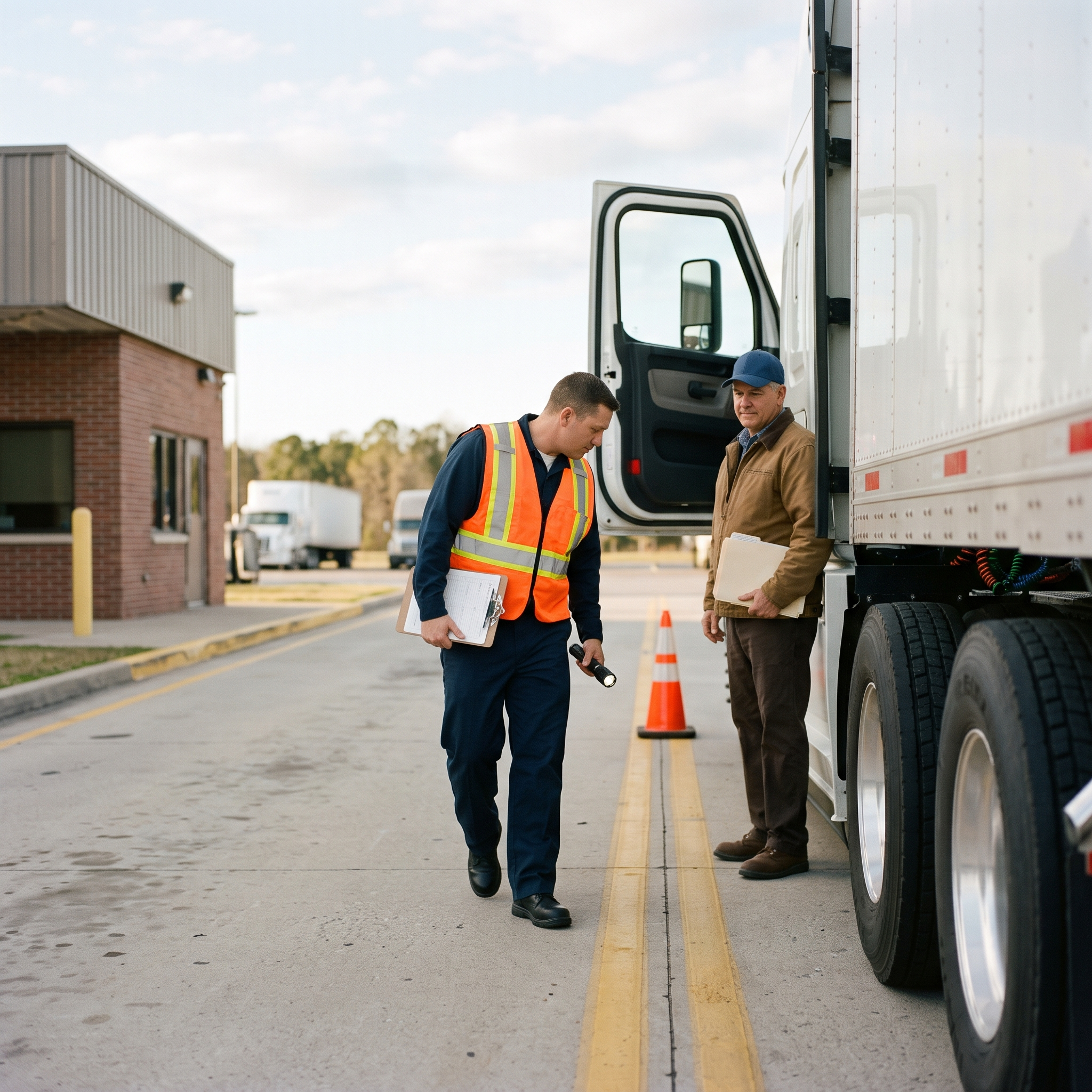
The scale light flips to “pull in.” Or a trooper waves you onto the shoulder. Either way, odds are good you’re about to get a Level 2 DOT inspection.
It’s the walk-around. No creeper, no crawling under the trailer. But don’t let that fool you. A Level 2 can still put your truck out of service, sideline your driver, and hit your CSA score just as hard as a full Level 1.
Here’s exactly what officers check, what fails most often, and how to keep your truck moving.
What Is a Level 2 DOT Inspection?
A Level 2 DOT inspection is the CVSA North American Standard Walk-Around Driver/Vehicle Inspection. The officer reviews the driver’s documents and inspects every vehicle component that can be checked without physically getting under the truck.
Most Level 2s run 30 to 45 minutes. You’ll see them at weigh stations, ports of entry, and roadside pull-overs — anywhere an officer wants a solid look at a truck without the time a full inspection takes.
They’re common, too. During CVSA’s 2025 International Roadcheck, roughly 23% of all inspections were Level 2.
Level 1 vs. Level 2 vs. Level 3 DOT Inspections
| Level | Name | What’s Covered |
|---|---|---|
| Level 1 | North American Standard Inspection | Full driver + vehicle, including under-vehicle checks |
| Level 2 | Walk-Around Driver/Vehicle | Full driver review + everything visible without going under the truck |
| Level 3 | Driver/Credential/Administrative | Driver and paperwork only — no vehicle inspection |
| Level 5 | Vehicle-Only | Vehicle inspected with no driver present |
Bottom line: a Level 2 is a Level 1 minus the under-truck work. Everything else is fair game.
Why Your Truck Got Pulled In
Officers don’t pick trucks at random as often as drivers think. A high CSA score, a carrier with a history of violations, or a visible defect — a dead marker light, a low tire, a loose strap flapping in the wind — all raise the odds you’ll be waved in.
Weigh station bypass systems use your carrier’s safety data, too. A poor inspection history means fewer green lights and more stops. Clean inspections are how you break that cycle.
What Officers Check on the Driver Side
Expect the officer to start with you and your paperwork. This is where a lot of trucks get stopped before anyone looks at a tire.
CDL and Medical Card
The officer verifies your CDL is valid, the right class, and carries the endorsements your load requires. They’ll also check your Medical Examiner’s Certificate (and Skill Performance Evaluation certificate, if one applies).
Don’t brush this off. In the 2026 International Roadcheck, a missing medical card was the #1 driver out-of-service violation — 1,072 violations, or 27% of all driver OOS violations.
Hours of Service and ELD Records
Your record of duty status gets a close look. Officers check:
- Hours of service compliance (11-hour, 14-hour, 60/70-hour limits)
- A working, registered ELD — or a valid exemption
- ELD user manual, malfunction instruction sheet, and a supply of blank paper logs
- Signs of false logs or ELD tampering
False records of duty status and ELD tampering both made the 2026 Roadcheck list of top driver out-of-service violations.
English Language Proficiency
English language proficiency is enforced as an out-of-service violation again. Officers assess whether a driver can communicate with them and read highway signs. ELP violations accounted for 361 driver OOS orders during the 2026 Roadcheck alone.
Seat Belt, Impairment, and Carrier Status
Rounding out the driver review: seat belt use, any sign of alcohol or drug impairment, your driver vehicle inspection reports (DVIRs), and carrier identification and operating status — USDOT number, registration, and active authority.
What Officers Check on the Truck
Next comes the walk-around. The officer works every component visible from the ground.
Brake System (Visible Components)
Officers can’t measure pushrod stroke from under the truck on a Level 2, but they’ll still catch plenty:
- Audible air leaks and low-air warning function
- Chafed, kinked, or cracked brake hoses and tubing
- Damaged brake chambers and visible slack adjuster problems
- Tractor protection valve and parking brake operation
Brakes lead every out-of-service list. During CVSA’s 2026 Brake Safety Week, brake hoses and tubing alone produced 600 OOS violations.
Tires, Wheels, Rims, and Hubs
Tires are one of the easiest things for an officer to spot from the shoulder. Common write-ups:
- Tread below FMCSA minimums (4/32″ steer, 2/32″ all other positions)
- Exposed cord, sidewall bulges, cuts, or audible leaks
- Flat or underinflated tires
- Loose or missing lug nuts, cracked rims, leaking hub seals
Lighting Devices
Headlamps, brake lights, turn signals, clearance and marker lamps, and reflective tape. A single dead brake light is enough to get you written up.
Coupling Devices
Fifth wheel mounting, locking jaws, kingpin engagement, and safety chains on full trailers.
Cargo Securement
Officers count tiedowns, check working load limits, and look for frayed straps, damaged chains, and shifted loads. Cargo securement is a perennial top-five out-of-service violation.
Steering, Suspension, Frame, Exhaust, and Fuel
Excess steering wheel lash, broken leaf springs or air bags, cracked frame rails, exhaust leaks near the cab, and leaking fuel tanks or lines — anything visible from the ground.
Bus and Motorcoach Add-Ons
On passenger carriers, officers also check emergency exits, seating, and the electrical system. If you run buses, expect extra time here.
What Fails Most: Top Out-of-Service Violations
During the 2026 International Roadcheck, inspectors ran 44,047 Level 1, 2, and 5 vehicle inspections and logged 13,924 vehicle out-of-service violations. Here’s where trucks failed:
- Brake systems — 24.3% of all vehicle OOS violations. Add in “20% defective brakes” and brake-related issues hit 39.1%.
- Tires — consistently the #2 vehicle OOS violation.
- Lighting devices
- Cargo securement
On the driver side, the top failures were missing medical cards, hours-of-service problems, English language proficiency, and false logs.
The pattern is clear: most failures are things a driver could have caught on a 15-minute pre-trip.
What Happens If You Fail a Level 2 Inspection?
Out-of-Service Order
An out-of-service order means the truck or driver doesn’t move until the violation is fixed. Some fixes happen on the spot. Others — a blown air line, a cracked rim, a failed brake chamber — need a mobile mechanic at the scale or a heavy-duty tow to the nearest shop.
That’s where the clock starts costing you real money.
CSA Score Impact
Every violation lands on your carrier’s FMCSA record and feeds your CSA BASIC scores for 24 months. Out-of-service violations carry heavier severity weights, and a rising score means more inspections, tougher insurance renewals, and lost freight from shippers who check.
The flip side: a clean inspection actually helps your score.
How to Pass Your Next Level 2 DOT Inspection
Use this checklist before every trip:
Driver Documents
- Valid CDL with correct endorsements
- Current medical card in the cab
- ELD working, with manual, malfunction sheet, and blank logs on board
- Registration, annual inspection proof, and carrier authority current
Truck and Trailer Walk-Around
- Listen for air leaks with the system built up
- Check every hose and line for chafing
- Gauge tread depth and inspect sidewalls on every tire
- Check lug nuts and hub seals for rust trails or oil
- Walk the lights with a partner or a mirror check
- Re-check straps and chains after the first 50 miles
Fix what you find before you roll. A $40 air line at your yard beats a $1,500 out-of-service tow on the interstate.
Put Out of Service? Get Help in Under 3 Minutes
Sometimes you do everything right and a part still fails at the worst possible moment. When an officer puts your truck out of service, you need a vetted mobile mechanic or heavy-duty wrecker — not a Google search and a dozen unanswered calls.
Heavy Duty Help connects fleets, owner-operators, and bus owners with vetted towing and repair vendors in every U.S. state and across Canada. Over 800 trucking companies rely on our network, and our average vendor connection time is under 3 minutes.
Real Help. Real Fast. Real 24/7.
📞 Call 256-867-2257 or visit HeavyDutyHelp.com.
Owner-operators: RepairAndTowPros.com | Bus owners: BusAndRVRescue.com
Level 2 DOT Inspection FAQs
How long does a Level 2 DOT inspection take?
Most take 30 to 45 minutes, depending on what the officer finds.
Do you get a CVSA decal after a Level 2 inspection?
No. CVSA decals are issued only after a Level 1 or Level 5 inspection with no critical violations.
Can a Level 2 inspection put my truck out of service?
Yes. Any violation that meets the North American Standard Out-of-Service Criteria — brakes, tires, lights, securement, or driver issues — can ground the truck or driver.
What’s the difference between a Level 1 and Level 2 DOT inspection?
A Level 1 includes under-vehicle checks like brake adjustment. A Level 2 covers the same driver review and everything visible without going under the truck.
FAQPage Schema