
Last reviewed: November 4, 2026. Chain rules change. We recheck this page every quarter.
Chain season is here. Colorado started enforcing its must-carry law on September 1. Oregon’s signs go up in late September. California turns on chain controls at the first real storm on I-80 and I-5.
Here’s what each major chain state requires, a checklist you can print, and how to keep a chain-up from turning into a ticket or a tow.
What Chain Laws Require
There’s no federal chain law. Each state writes its own, and they come in two types:
- Must-carry laws. You need chains on board during a set season on set routes, whether it’s snowing or not.
- Chain-control laws. When signs or officers say chains, you install them before going any farther.
Here’s how the busiest chain states break down:
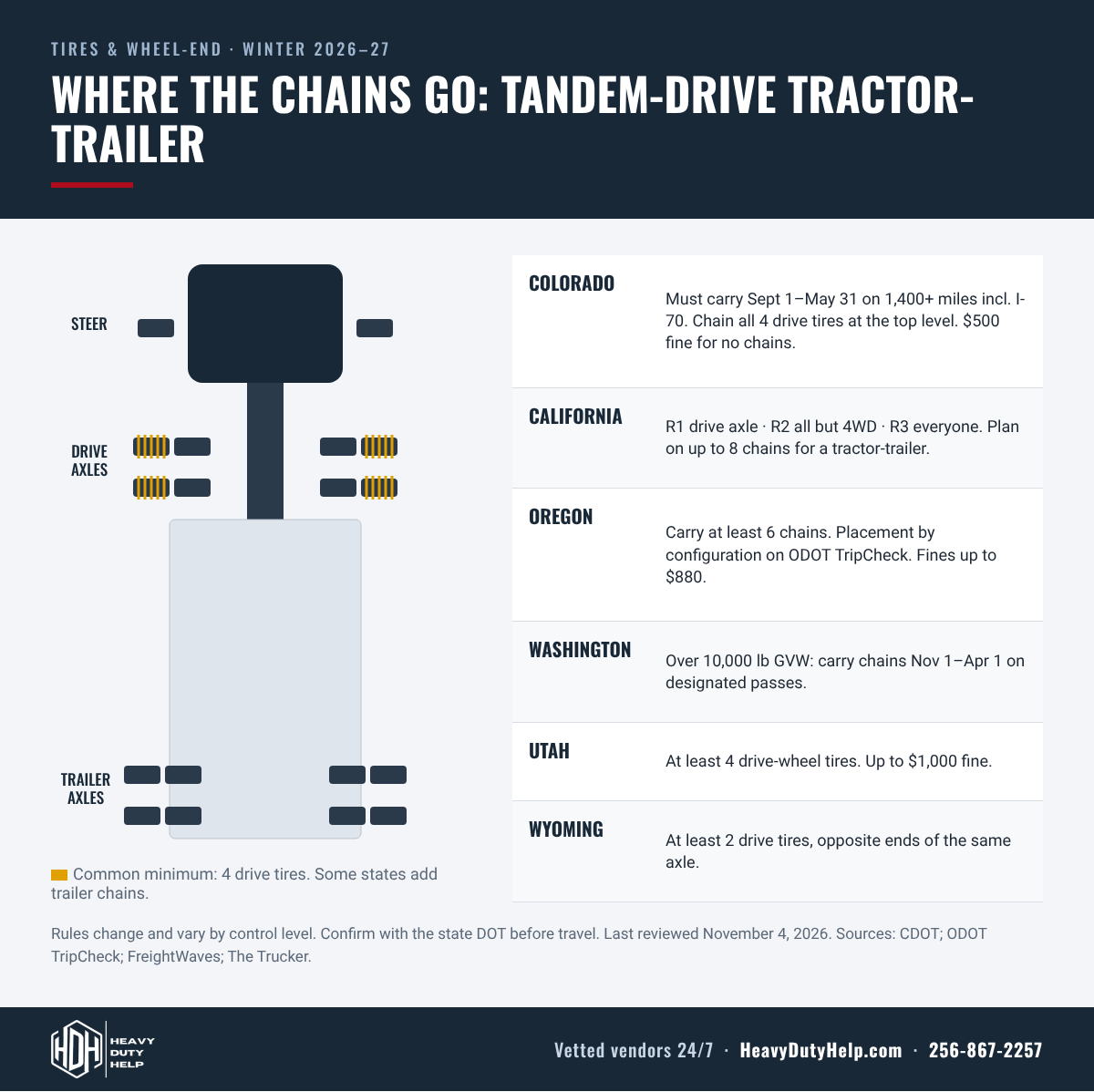
Colorado. From September 1 to May 31, every commercial vehicle must carry chains on more than 1,400 centerline miles of highway. That includes I-70 from mile marker 259 near Golden to mile marker 133 at Dotsero, plus sections of CO 9 and US 40, 50, 160, 285 and 550. The state has 130 chain stations, 22 of them on the I-70 mountain corridor. When the commercial chain law is in effect, single-drive-axle combinations chain up first. At the higher level, every commercial vehicle chains all four drive tires. Approved alternative traction devices are accepted.
California. Caltrans posts three levels. R1 requires chains or traction devices on the drive axle. R2 requires them on all vehicles except 4WD with snow tires. R3 requires them on all vehicles, no exceptions. Heavy trucks stop at chain control checkpoints. A standard tractor-trailer may need up to eight chains to comply.
Oregon. Chain requirements are posted by sign. Truckers should carry at least six chains. ODOT spells out placement by configuration. On a tandem-drive tractor with a semi-trailer, chain two tires per side on the primary drive axle, and add trailer chains where the rules for your configuration require them.
Washington. Commercial vehicles over 10,000 pounds GVW must carry chains from November 1 to April 1 on designated passes, including Snoqualmie and Stevens.
Other mountain states. Utah requires chains on at least four drive tires for trucks with four or more drive wheels. Wyoming requires at least two drive tires at opposite ends of the same axle. Nevada has no carry requirement, but you chain up when signs say so.
Heavy commercial vehicles don’t get a snow-tire exemption when chain controls are posted.
Who Chain Laws Apply To
Commercial motor vehicles. Colorado’s must-carry law covers vehicles over 16,000 pounds combined weight used in commerce, and vehicles carrying 16 or more passengers. Washington’s carry rule starts at 10,000 pounds GVW. Oregon’s placement rules cover vehicles of 26,001 pounds GVW and up.
Buses and motorcoaches. Colorado’s 16-passenger rule pulls in charter and school buses.
Out-of-state carriers. Your home state doesn’t matter. If you’re on a Colorado mountain corridor in October, you carry chains.
Exemptions are narrow. Some states let lighter vehicles use snow tires or 4WD at lower control levels. Heavy trucks almost never qualify. Always assume you need chains.
The Chain Law Checklist
Print this and keep it in the cab.
Before the season
- ☐ Chains sized to your exact tire size (11R22.5, 295/75R22.5, and so on). Wrong size = no chains.
- ☐ Enough chains for your toughest state: 6 for Oregon, up to 8 for California, 4 drive tires for Colorado and Utah.
- ☐ A spare cross-chain set, repair links and a link tool
- ☐ Chain tighteners: cam tighteners or rubber adjusters
- ☐ Waterproof gloves, headlamp, reflective vest, kneeling pad or tarp
- ☐ If you run them, alternative traction devices approved for the state you’re in
- ☐ A dry-run install in the yard, so the first time isn’t in a blizzard at night
On every pre-trip in chain season
- ☐ Chains on board and counted
- ☐ No broken cross links, cracked hooks or stretched side chains
- ☐ Chains stored dry and untangled, ready to lay out
- ☐ Route checked on the state 511 site: COtrip, Caltrans QuickMap, ODOT TripCheck or WSDOT
- ☐ Chain-up and chain-off areas on your route noted
- ☐ Tire pressure checked. Chains fit poorly on low tires.
At the chain station
- ☐ Pull fully off the travel lane, hazards on, vest on
- ☐ Lay chains flat, hooks facing out, cross links facing up
- ☐ Drape or drive onto the chains, then center them on the tread
- ☐ Fasten the inside hook first, then the outside
- ☐ Tension evenly, with no slack hanging near the brake chambers or air lines
- ☐ Drive a quarter mile, stop, retighten
- ☐ Keep speed at 25–30 mph or less with chains on
- ☐ Remove chains only in the posted chain-off area
After the pass
- ☐ Rinse and dry the chains before storing
- ☐ Replace any broken links before the next trip
- ☐ Note the chain-up and any damage on your DVIR
Common Chain Law Violations
From most to least common in enforcement reports:
- Not carrying chains in a must-carry zone. The ticket Colorado writes most. Officers issued more than 1,300 chain citations in the 2024–2025 season.
- Not chaining up when controls are posted. Driving past a chain station on a closed or chain-required pass.
- Too few tires chained. Chaining two tires when the state requires four drive tires, or skipping required trailer chains.
- Wrong-size or broken chains. Chains that don’t fit or that fail on the climb count as no chains.
- Blocking the highway. Spinning out or jackknifing without chains and closing a lane. This one carries the biggest fines.
Chain Law Penalties and Consequences
- Colorado: $500 for not carrying chains during the must-carry season. Up to $1,000 plus surcharge if a truck without chains blocks the roadway.
- Oregon: Fines as high as $880 for not using chains when required.
- Utah: Up to $1,000, charged as a Class B misdemeanor.
- California: CHP cites trucks that don’t comply at chain controls, and trucks get turned around at checkpoints.
The fine is the small part. A truck that spins out on a closed pass means a heavy-duty recovery, a possible crash report and a missed load. On I-70, it can mean being the reason the whole interstate shuts down.
How to Prepare for Chain Season
Buy chains early. Heavy-duty tire shops stock truck chains, but sizes sell out once storms hit. Find a heavy-duty tire shop near you that sells and installs them.
Train every driver. A practice install in the yard beats the first try on a dark shoulder. Make chain-up part of winter orientation.
Put chains on the pre-trip. Add “chains on board and serviceable” to every pre-trip from September through May. Our DOT inspection checklist covers the rest of the walk-around.
Plan routes around controls. Check 511 before dispatching over Donner, Vail, Snoqualmie or Siskiyou. A two-hour delay beats a closed-pass recovery.
Get tires right first. Chains work best on properly inflated tires with good tread.
Look at alternatives where they’re allowed. Some fleets carry approved textile traction devices for the states that accept them. They go on faster and weigh less. They don’t replace chains everywhere, so carry both where the rules require chains.
Watch the forecast, not just the calendar. Early storms on Vail Pass and Donner hit before many drivers expect them. Chain-season preparation should be finished by October.
Check brakes before the climb. Mountain descents punish brakes that are out of adjustment.
Know who to call. If a truck spins out or a chain fails and wraps an axle, you need heavy-duty recovery that works the passes.
What a Skipped Chain-Up Really Costs
Do the math before you decide the chains can wait.
- The chains: a pair for 11R22.5 duals runs about $240–$350 at retail. Chaining all four drive tires takes two pairs, so roughly $500–$700.
- The ticket: Colorado’s fine for not carrying chains is $500. That’s about what one pair costs.
- The recovery: a heavy-duty winch-out or recovery after a spin-out commonly runs $3,000–$10,000 or more. Towing rate sheets filed with the Idaho Transportation Department show winch-outs billed around $475 an hour per truck, and a rotator call at $1,250.
- The downtime: the missed delivery window, a possible crash report, and hours sitting on a closed pass. None of it shows on the recovery bill.
A full set of chains costs less than two hours of heavy-duty recovery. Buy them, carry them and practice with them.
Tire Chain FAQs
How many tire chains does a semi truck need?
It depends on the state. Colorado and Utah require chains on four drive tires. Oregon expects at least six chains on board. California can require up to eight on a tractor-trailer. Carry for the strictest state on your route.
When is chain season in Colorado for trucks?
Colorado’s commercial must-carry season runs September 1 through May 31 on more than 1,400 miles of designated highway, including I-70 between Dotsero and Golden.
Can I use AutoSocks instead of chains on a semi?
Some states accept approved alternative traction devices. Colorado does on its chain-law corridors. Rules vary by state and control level, so confirm before you rely on them.
How fast can a semi drive with chains on?
Keep it at 25–30 mph or slower. Faster speeds break chains and can damage tires, brake chambers and air lines.
What’s the fine for not carrying chains in Colorado?
$500 during the must-carry season. Blocking the road because you didn’t chain up can cost up to $1,000 plus surcharge.
Spun Out or Chain Down? Get a Vetted Vendor in Under 3 Minutes
Truck stuck on a mountain pass? Heavy Duty Help connects you with vetted heavy-duty towing and recovery, mobile tire service and repair vendors, in every U.S. state and across Canada, 24/7.
- Fleet dispatchers: Search by service and location at HeavyDutyHelp.com. Trusted by 800+ major trucking companies.
- Owner-operators: Find help fast at RepairAndTowPros.com.
- Bus and RV owners: Go to BusAndRVRescue.com.
Or call 256-867-2257. A live team member finds a vetted vendor near you and connects you by phone, with an average time under 3 minutes. Free to use. No automated dead ends.
Real Help. Real Fast. Real 24/7. Keep America Moving.
Vendors: Do mountain-pass recovery or roadside tire service? Get in front of 800+ fleets with one flat annual listing. No bidding, no rotation. Join the network.
Chain laws, seasons and fines are set by each state and change often. Confirm current requirements with the state DOT before you travel. Last reviewed November 4, 2026.