
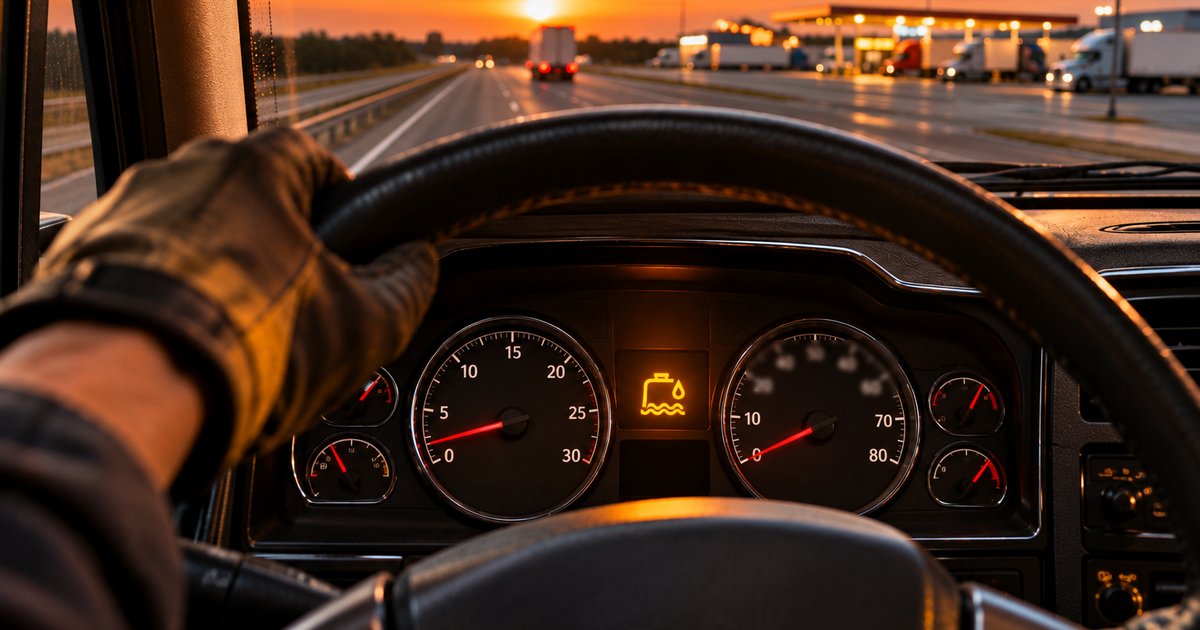
The amber DEF light comes on somewhere between Amarillo and Albuquerque. The load is due tomorrow. Two questions hit at once: what broke, and how far can you push it?
Here is the straight answer on both, plus what the fix costs and how to get a heavy-duty shop on the line fast.
What the DEF Light Means
DEF stands for diesel exhaust fluid. Every diesel truck built since 2010 sprays it into the exhaust, where the SCR catalyst uses it to turn NOx into nitrogen and water. If you need the basics on the fluid itself, start with our diesel exhaust fluid guide.
The DEF light tells you the truck can’t confirm that system is doing its job. It shows up three ways:
- Solid DEF light. Usually low fluid. On most trucks it comes on at roughly 10% of the tank.
- Flashing DEF light. The tank is close to empty, or the countdown to a derate has started.
- DEF light plus check engine light. The problem is not the level. It’s a fault: bad fluid, a failed sensor, a frozen line, a stuck doser.
Federal emissions rules require the truck to “induce” a repair. That’s the derate. The light is the truck’s warning that it is coming.
Common Causes of a DEF Light
Ordered from most to least likely.
1. Low DEF level. The easy one. Most Class 8 tanks hold 5 to 23 gallons, and an OTR truck burns about 2–3% of its diesel volume in DEF. Skip two top-offs and you’ll see the light.
2. Bad or diluted DEF. The quality sensor in the tank reads urea concentration. Spec is 32.5% under ISO 22241. Off-brand fluid, old fluid cooked in a hot side box, or a tank someone topped off with tap water will all trip it.
3. Frozen DEF or a failed heater. DEF freezes at 12°F. The tank and lines are heated, and the truck runs while it thaws. If a heater element or relay fails, the system never thaws. Expect a lot of these calls from November on.
4. Failed tank sensor. Level, quality and temperature sensors usually live in one tank header assembly. When it fails, the truck reports a problem with fluid that’s actually fine.
5. Crystallized or clogged doser. DEF dries into white crust. When it builds up in the doser nozzle or the lines, the SCR can’t get fluid and throws a dosing or efficiency code.
6. DEF pump or filter failure. No pressure, no dosing. Common on higher-mileage trucks.
7. NOx sensor failure. The NOx sensors grade the SCR’s work. A dead sensor can light the DEF lamp even when the fluid side is healthy.
How to Diagnose a DEF Light
Run this list in order. Steps 1 through 5 can be done roadside. Steps 6 and 7 need a shop or a mobile tech with a laptop.
- Check the gauge, then look in the tank. Don’t trust the gauge alone.
- Note how the light behaves. Solid, flashing, or paired with the check engine light. Write it down.
- Pull the codes. Most dashboards show active fault codes. Note the SPN and FMI. Common ones: SPN 1761 (DEF tank level), SPN 3364 (DEF quality), SPN 3361 (dosing unit), SPN 4364 (SCR conversion efficiency).
- Check the fluid. It should be clear with no smell. A refractometer reading outside 31.8–33.2% means bad fluid. Drain it. Don’t top it off and hope.
- Look for crystals and leaks. White crust around the doser, pump or line fittings points to a leak or a clog.
- Shop step: test sensors, heaters and the pump. This takes OEM software: Detroit DiagnosticLink, Cummins INSITE, Volvo and Mack Tech Tool, or PACCAR ESA.
- Shop step: check for a software update. Many OEMs are now flashing in-service trucks with a gentler derate schedule. Your dealer can tell you if your truck has it.
Can You Keep Driving With the DEF Light On?
If it’s low fluid: yes. Fill it at the next DEF pump and the light clears.
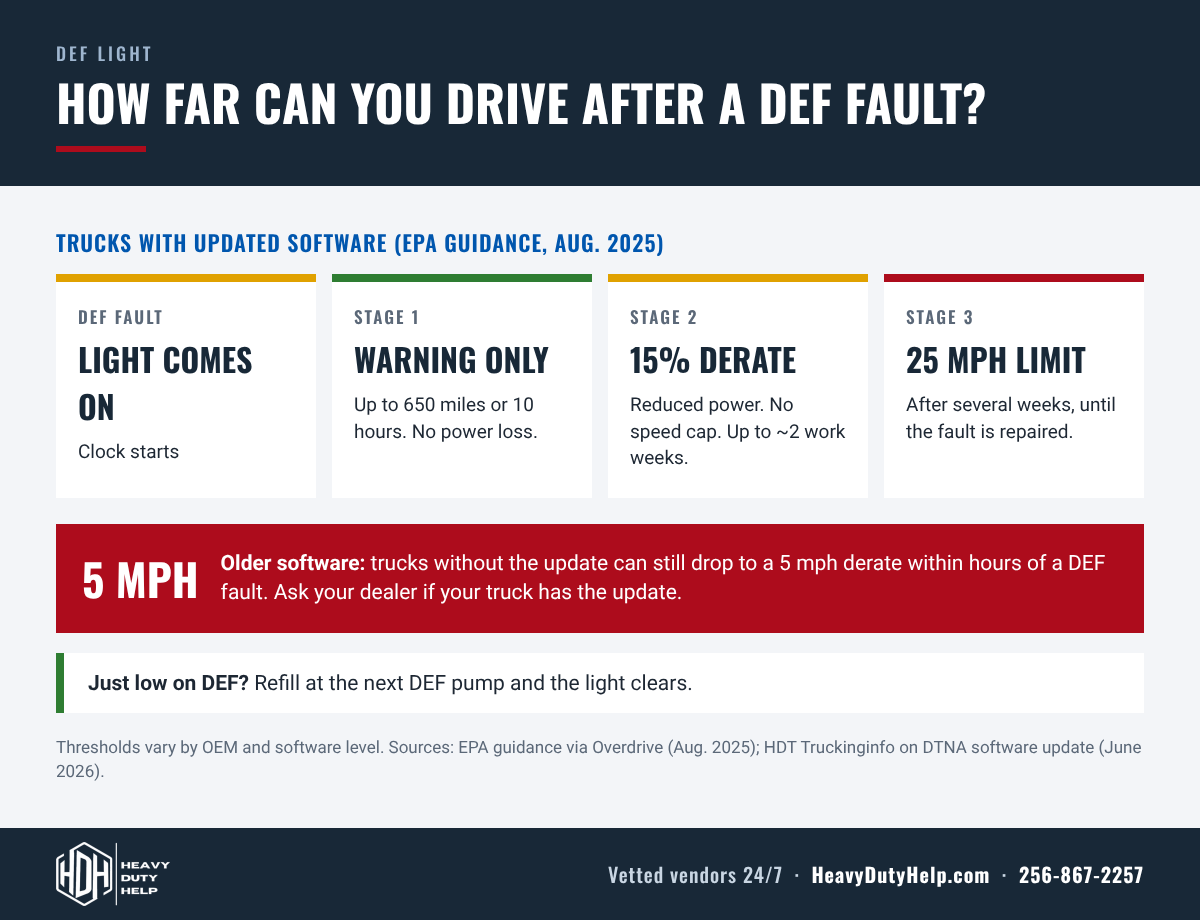
If it’s a fault: it depends on your software. Under EPA guidance issued in August 2025, updated trucks give you a warning-only window of 650 miles or 10 hours. Then comes a 15% power derate with no speed cap. Only after several more weeks does the truck drop to 25 mph. Daimler Truck North America is rolling that update out to about 330,000 Detroit-powered trucks (DD15 model years 2021–2025, DD13 model years 2022–2025).
Trucks without the update can still hit a 5 mph derate within hours of a fault. Don’t assume you have time. Get it diagnosed the same day.
What a DEF Light Repair Costs
Prices below are ranges, not quotes. Parts and labor are split where sources allow.
| Repair | Typical cost | Notes |
|---|---|---|
| Refill DEF at the pump | $2.80–$3.75 per gallon | Jugs run up to $10+ per gallon |
| DEF doser / injector | $200–$600 | Often a mobile job |
| NOx sensor | $500–$1,500 installed | Varies by OEM and access |
| DEF pump | $500–$1,200 | Parts and labor |
| Contaminated DEF flush to catalyst damage | $800–$5,500 | Depends on how far it got |
| Shop labor rate | $140–$180/hr independent, $175–$225/hr dealer | Mobile call-outs add $150–$300 |
Ranges come from the Heavy Duty Help aftertreatment cost guide, published heavy-duty repair cost guides, and 2026 truck stop pump pricing. Your price depends on OEM, region, parts availability and whether the work is done roadside.
The expensive line on most invoices isn’t a part. It’s the downtime while the truck sits in derate.
Finding a Shop for a DEF Problem
Not every diesel shop is set up for aftertreatment. Before you send a truck, ask four things:
- Do you have OEM software for my engine? Generic scan tools read codes. They can’t run DEF heater, pump and doser tests, or check for a reflash.
- Do you stock NOx sensors and DEF parts? Some OE sensors are on backorder for weeks. A shop with parts on the shelf saves days.
- Can you come to me? Sensors, dosers, wiring and fluid problems are often fixable roadside by a mobile tech.
- Are you open now? A DEF fault at 2 a.m. still has a clock running.
Search DPF and aftertreatment shops near you on Heavy Duty Help, or see what a plugged filter costs in our DPF cleaning guide.
DEF Light FAQs
How far can I drive with the DEF light on?
If the tank is just low, you have time to reach a DEF pump. If it’s a fault, updated trucks allow about 650 miles or 10 hours before a 15% derate. Older software can drop you to 5 mph within hours. Get it checked the same day.
Why is my DEF light on when the tank is full?
The problem isn’t the level. The most common causes are bad or diluted fluid, a failed tank sensor, a frozen line or a failed heater, a clogged doser, or a bad NOx sensor. Pull the codes before you buy parts.
Will the DEF light go off by itself?
After a refill, usually yes, sometimes after a key cycle or a short drive. A fault-driven light stays on until the problem is repaired and the code clears.
Can I add water or anything else to the DEF tank?
No. Tap water carries minerals that damage the SCR catalyst. Additives and antifreeze do the same. Use API-certified DEF only.
Does cold weather cause the DEF light?
It can. DEF freezes at 12°F, and the truck’s heaters thaw it while you drive. If a heater fails, the fluid stays frozen and the light comes on.
Get a Vetted DEF and Aftertreatment Vendor in Under 3 Minutes
DEF light turned into a derate? Heavy Duty Help connects you with vetted heavy-duty mobile mechanics, repair shops and towing and recovery vendors, in every U.S. state and across Canada, 24/7.
- Fleet dispatchers: Search by service and location at HeavyDutyHelp.com. Trusted by 800+ major trucking companies.
- Owner-operators: Find help fast at RepairAndTowPros.com.
- Bus and RV owners: Go to BusAndRVRescue.com.
Or call 256-867-2257. A live team member finds a vetted vendor near you and connects you by phone, with an average time under 3 minutes. Free to use. No automated dead ends.
Real Help. Real Fast. Real 24/7. Keep America Moving.
Vendors: Do DEF, SCR or mobile diesel repair? Get in front of 800+ fleets with one flat annual listing. No bidding, no rotation. Join the network.
Cost ranges are general industry estimates for Class 8 and comparable heavy-duty diesel equipment and will vary by OEM, region, parts availability and whether the repair is done roadside or in-shop. Heavy Duty Help connects clients with independent vendors and does not set or negotiate repair pricing.